

Between extreme weather, surging claim volumes, and rising customer expectations, P&C insurers are feeling the heat. Every ticket, call, and coverage question adds pressure to customer service teams already stretched thin.
Fortunately, conversational AI in insurance can resolve the most common (and costly) questions insurers face every day, and it’s already proving how powerful AI use cases in insurance can be when applied to real service volume.
But here’s the bigger shift: with the right AI for insurance claims in place, automation doesn’t stop at simple FAQs. A modern AI customer service platform can authenticate policyholders, interpret policy language, update systems, and orchestrate multi-step workflows—meaning insurers can automate not just basic tasks, but complex, high‑value processes across the entire policy and claims journey.
This post is part of our AI agent in the field series: a look at how real AI customer service agents are resolving the high-volume, high-impact conversations property and casualty insurance teams face every day. Let’s explore 5 use cases for AI in P&C insurance that are helping customer service teams reduce cost to serve, scale support, and deliver fast, accurate, consistent support at every step.

What are the most valuable AI use cases for P&C insurance customer service?
AI has become table stakes in customer service, but not all automation delivers the same impact.
For P&C insurers, the best returns come from applying AI to automate conversations that are both frequent and frustrating: claim status updates, document requests, and billing or coverage questions. These are the types of interactions that drive up ticket volume, delay resolution, and drain licensed reps.
But they’re also the moments that define the customer experience. Get them right, and you improve satisfaction, reduce churn, and protect margins.
That’s what makes these AI use cases in insurance worth prioritizing. Each one is tied to a high-value workflow, and when automated with the right AI customer service platform, they don’t just reduce cost to serve. They transform service into a strategic advantage.
5 key use cases for AI customer service in P&C insurance
1. Real-time claims status updates
Claims are one of the most emotionally charged and operationally complex parts of the insurance journey.
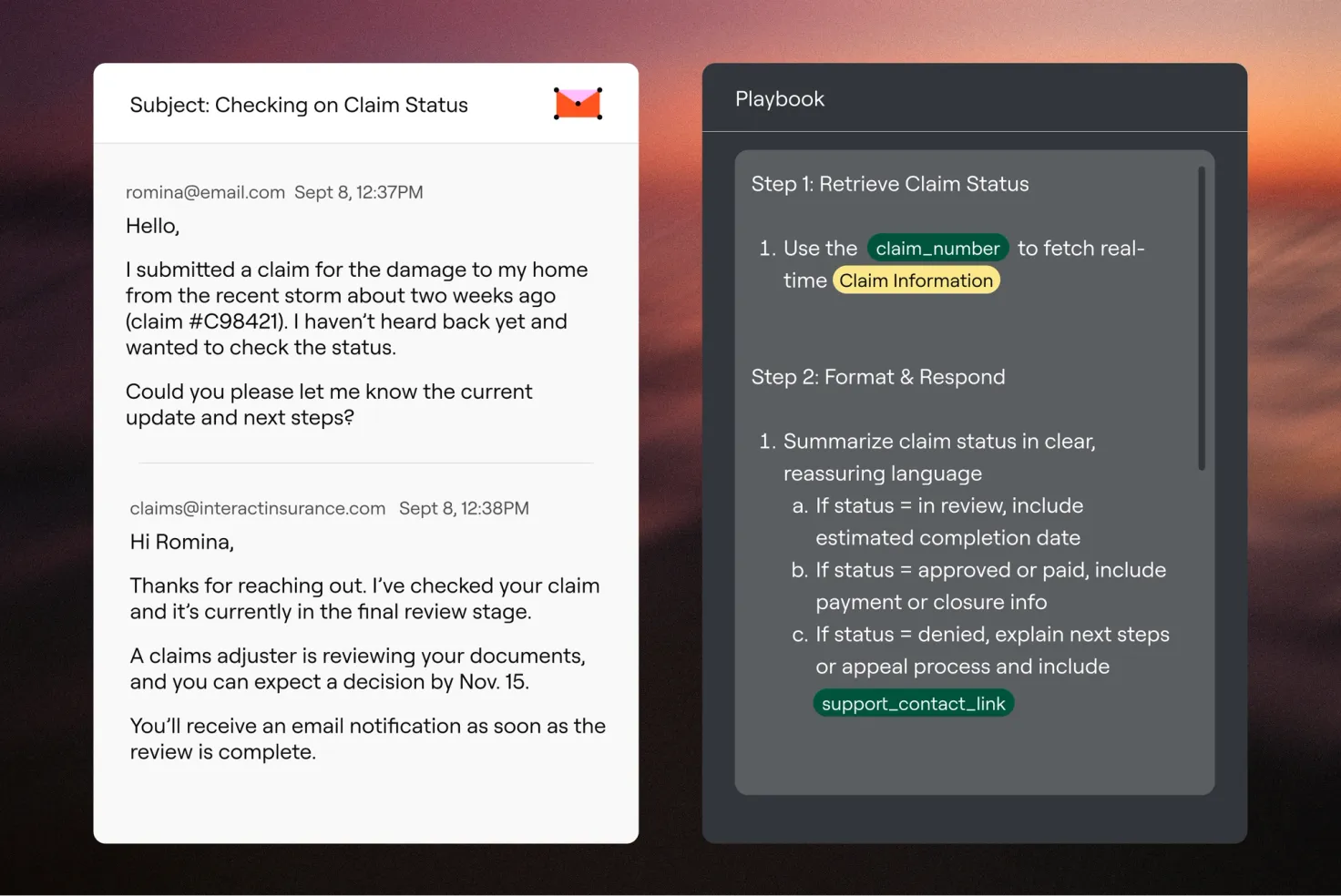
They generate high volume, high expectations, and intense scrutiny. Policyholders want transparency. Agents want to stay focused on resolution. But too often, teams get stuck answering the same question over and over: “What’s going on with my claim?”
When handled manually, this constant back-and-forth increases volume, slows down resolution, and pulls agents away from more complex or urgent cases. But with the right AI for insurance claims in place, you can automate claim updates without compromising empathy or accuracy.
AI agents can:
- Authenticate the policyholder
- Access and interpret real-time claim data
- Share clear updates on the claim stage, required next steps, and estimated completion
- Escalate to a human if timelines are unclear or the case is delayed
It’s a high-pressure use case, but one that AI can now handle end-to-end, giving policyholders clarity when they need it most.
2. Coverage explanation and eligibility checks
Coverage questions are deceptively simple on the surface, but tough to handle at scale.
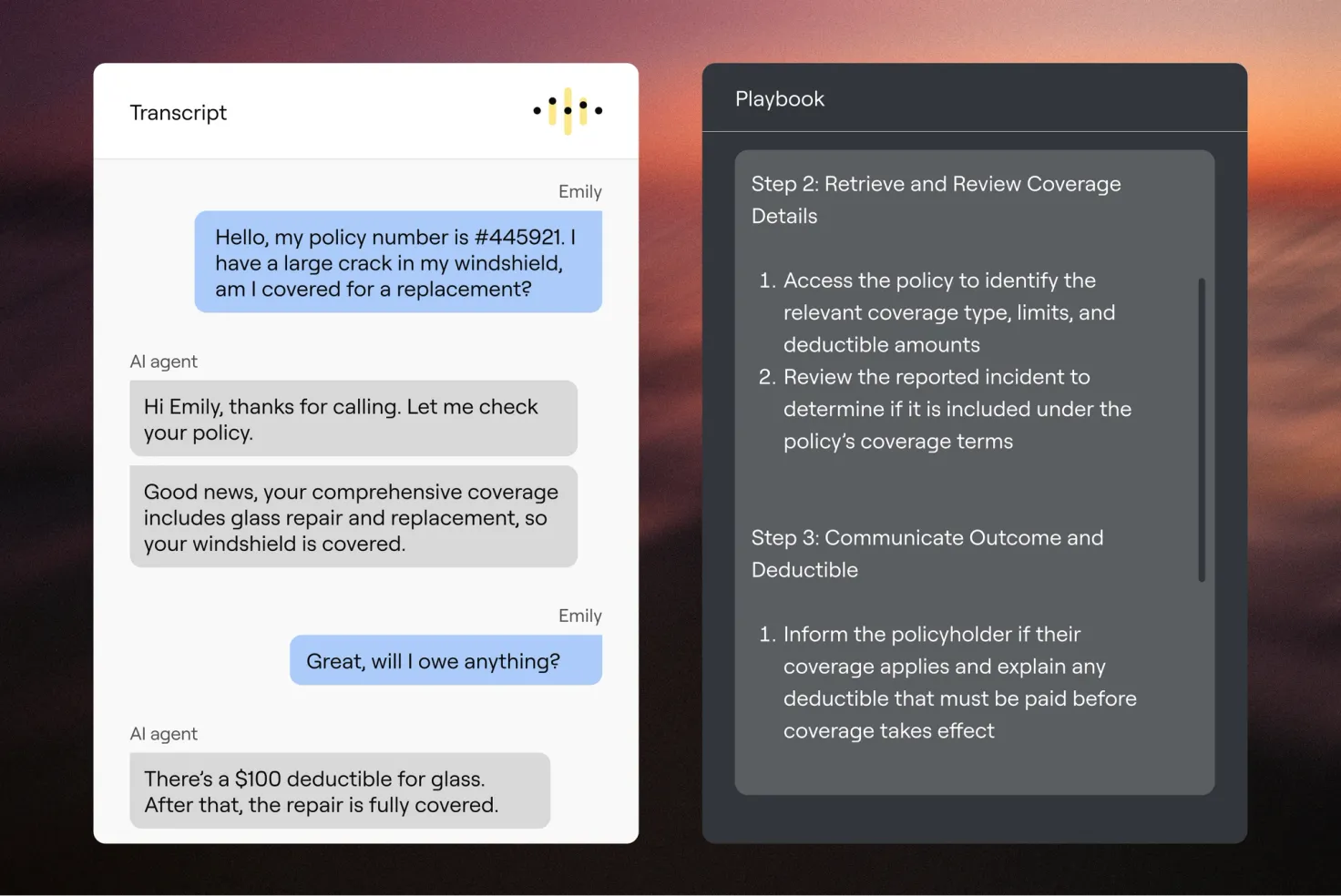
Policyholders might ask, “Does my policy cover a cracked windshield?” or “Am I covered for water damage?” The real answer often depends on endorsements, exclusions, and nuanced policy language that takes time to interpret.
For agents, it’s high-effort work. For customers, delays and inconsistency can cause confusion or mistrust. With the right AI agent, these interactions become fast, consistent, and clear.
AI agents can:
- Authenticate the customer and retrieve their specific policy
- Analyze coverages and limitations based on the inquiry
- Explain eligibility in natural language—no legalese
- Escalate edge cases or vague scenarios to licensed staff
This gives policyholders the confidence to act and insurers the assurance that answers are accurate, consistent, and on-brand.
3. Policy changes and endorsements
Changing a policy sounds easy, but it’s often anything but. A request to add a driver or update an address might trigger eligibility checks, pricing changes, backend system updates, or even regulatory review.
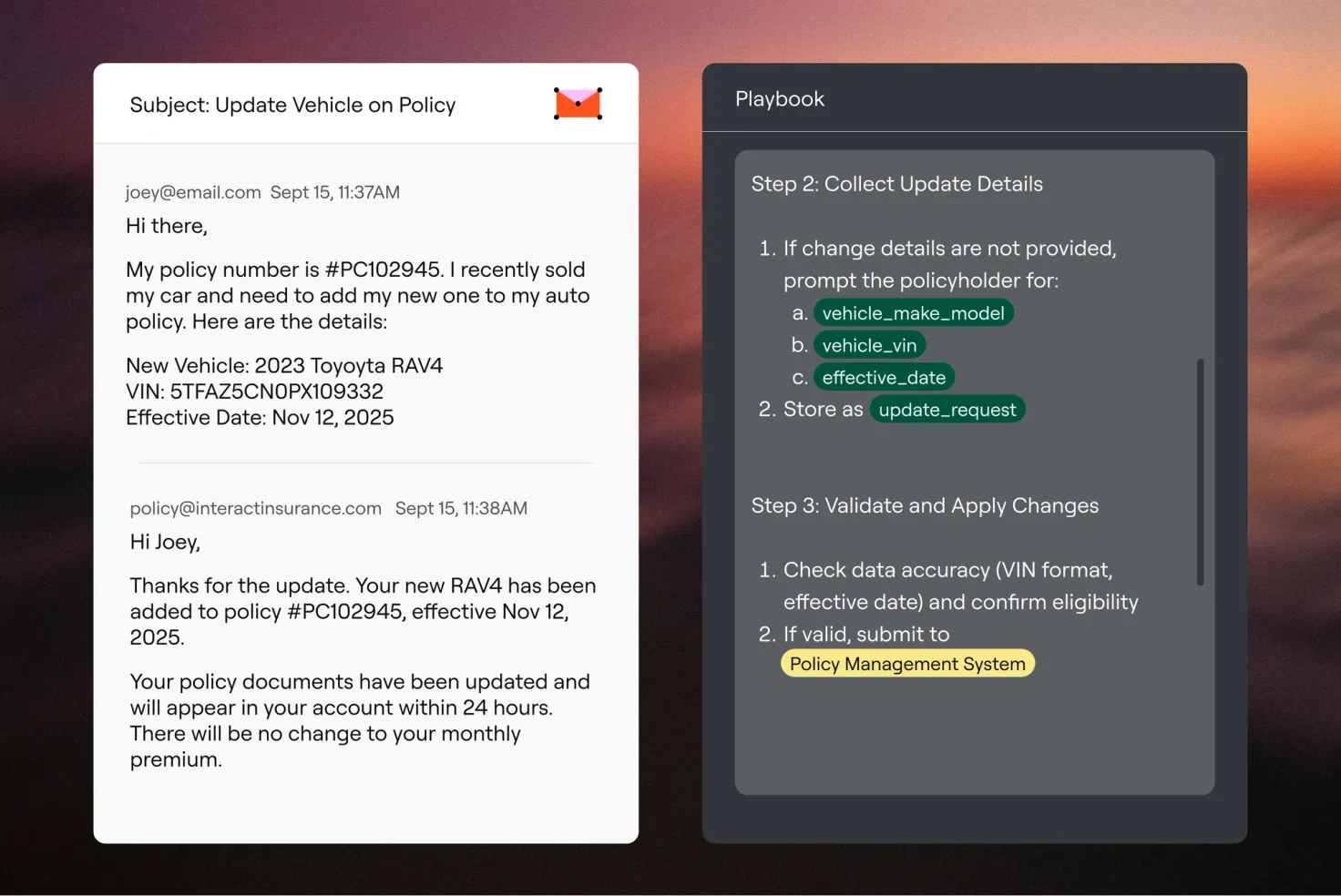
These are high-volume requests that can slow everything down, especially when handled manually. Think of how often a customer asks something like, “How do I add my new car to my policy?”
With the right AI agent, insurers can streamline this entire workflow. AI agents can:
- Collect and verify change requests from authenticated policyholders
- Determine impact on coverage or pricing
- Submit changes to internal systems in real time
- Confirm completion and notify the customer
That means faster updates, fewer manual errors, and a more flexible, digital-first experience that today’s policyholders expect.
4. Policy renewals and processing
Renewals are a critical moment in the policyholder lifecycle—and a risky one. If the process is too slow, too complicated, or too opaque, policyholders may lapse or churn.
That’s why customers often search things like “Can I renew my policy online?” and end up calling when self-serve options fall short.
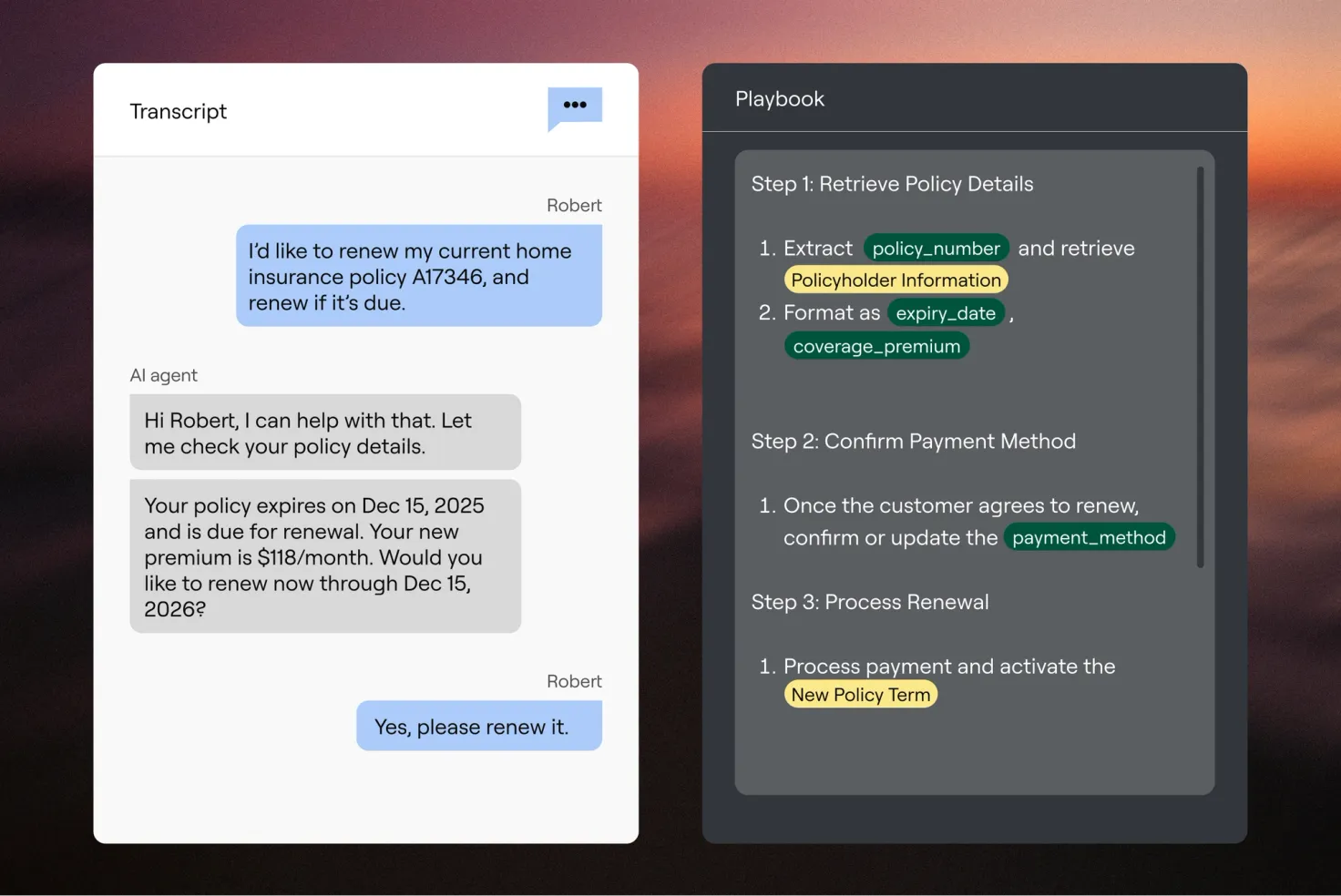
AI for P&C insurers can simplify renewals and reduce churn by:
- Authenticating the customer and retrieving renewal eligibility,
- Presenting updated terms or options for review,
- Processing payments and activating a new policy term, and
- Confirming coverage and completion.
This takes pressure off human agents during peak renewal periods and helps policyholders stay covered without hassle.
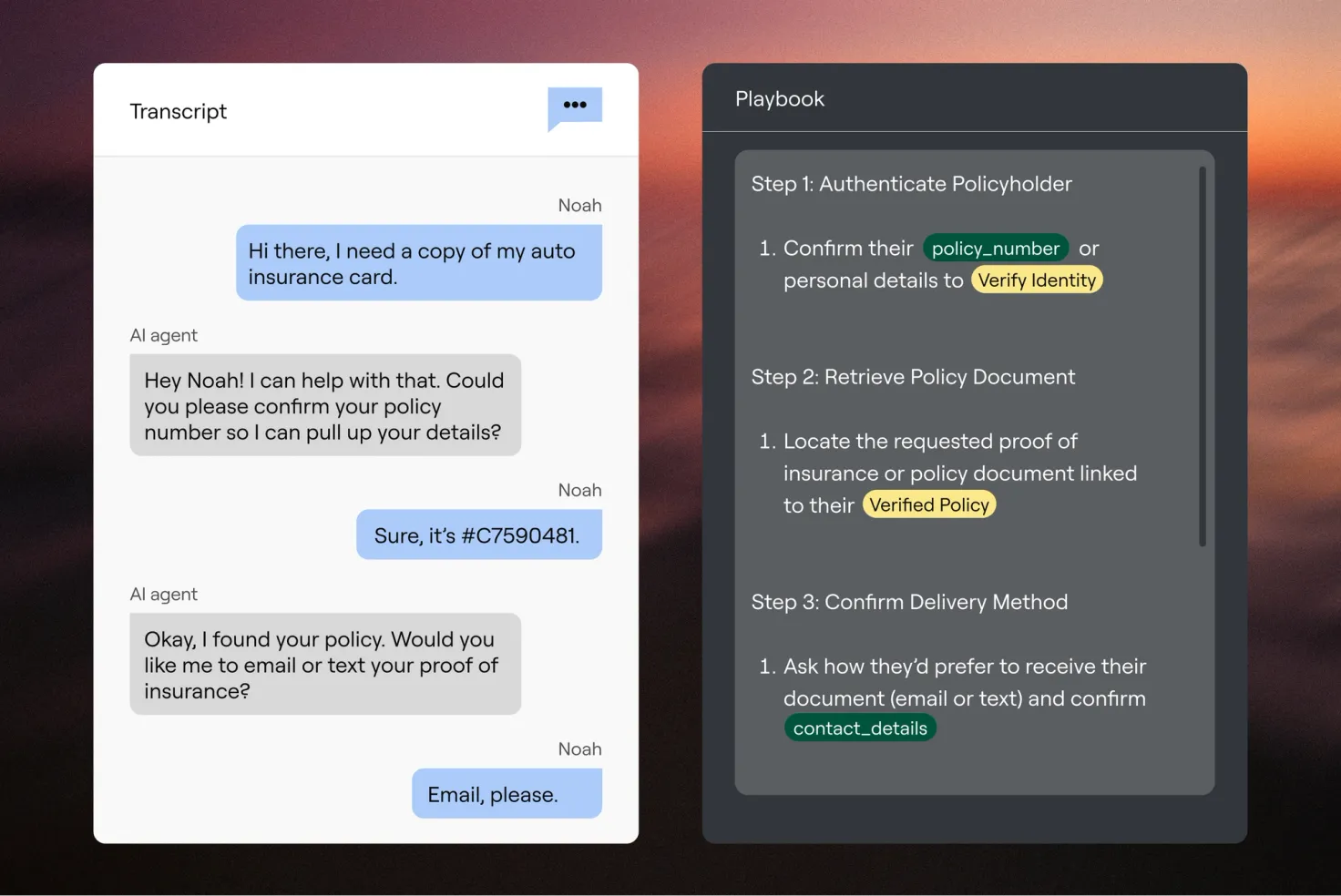
5. Proof of insurance on demand
Policyholders need proof of insurance in all kinds of high-friction moments: leasing a car, closing on a home, or renewing a driver’s license. These requests are urgent, frequent, and often tied to external deadlines.
Customers don’t want to dig through their inbox or call in to ask, “Can you send me my insurance card?” With the right AI agent, they don’t have to.
AI agents can:
- Authenticate the customer and retrieve the correct document
- Deliver ID cards, policy PDFs, or certificates via the preferred channel
- Confirm delivery and track fulfillment
It’s one of the simplest but most satisfying use cases to automate, and it’s a great place to start reducing inbound volume right away.
Turn AI use cases into real outcomes with Playbooks
Knowing what to automate is one thing. Knowing how to automate it—and how to do it well—is something else entirely.
That’s where Playbooks come in.
Ada’s Playbooks for P&C insurers are designed to help teams move from strategy to execution with speed and confidence. Each Playbook maps to a real insurance workflow—like claims status, policy renewals, or proof of insurance—and provides clear, tested guidance on how an AI agent should resolve it. That includes how to structure the conversation, when to escalate, and what success looks like.
They’re built to scale. Easy to customize. And ready to deploy fast.
Every use case featured in this post is based on real-world deployments. Playbooks show exactly how AI agents are performing in the field, and how to turn that success into repeatable, scalable results.
Discover how Playbooks unlock more complex AI resolutions
Browse real examples of AI agents using plain-language instructions to automate multi-step processes with speed and precision.
Explore Playbooks